
Ans: MDPE pipes are flexible, medium-density, and impact-resistant, while HDPE pipes are high-density, stronger, and suited for heavy-duty applications.
Difference Between MDPE and HDPE Pipes
A report from Grand View Research found that the global market for plastic pipes is expected to exceed $89 billion by 2030 due to increased utilization for water supply, agriculture, and industrial sectors.
There are two types of polyethylene that are commonly used for water infrastructure and industrial applications. They vary by density, strength, and application suitability, which is of utmost importance for the engineers, contractors, and decision makers who must select which material to use.
This article will compare these two types of pipe with respect to their structure, performance, applications, and long-term advantages so that you will be better prepared to select a material to suit your needs.
Understanding MDPE Pipes and HDPE Pipes
While MDPE Pipes and HDPE Pipes are given names based on their polymer density ranges, the nominal grading of newer grades of resin (e.g., PE80, PE100, PE4710) is becoming increasingly more useful (rather than density alone).
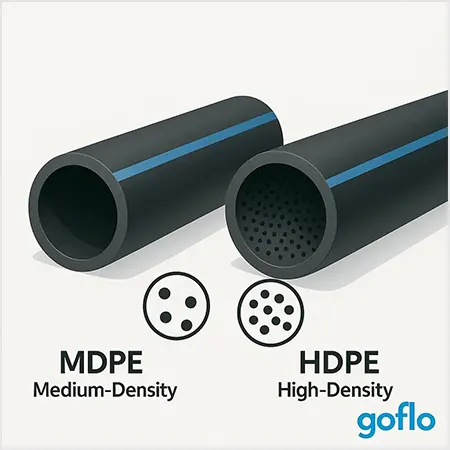
HDPE typically utilizes a higher weight of polymer and a tighter molecular structure, therefore giving it both higher strength and better resistance to slow crack growth.
On the other hand, MDPE Pipes has been designed to be tougher and more flexible and has a lower density, and therefore has an application for the lower-pressure water mains.
Key Differences Between MDPE Pipes and HDPE Pipes
Now let’s talk about the key differences between MDPE Pipes and HDPE Pipes. This includes:
Material Properties
Density is merely an indication of materials. The actual performance of materials applicable today is dictated by differences in molecular weight distribution, branching (unimodal vs bimodal resins), and additives (carbon black, stabilisers, antioxidants).
The molecular structure of HDPE affords it greater tensile strength, faster crack propagation resistance, and longer-term hydrostatic strength. MDPE water pipe, on the contrary, is usually more ductile and therefore forgiving to bend and lift, which is useful in applications where flexibility and installation ease count.
Strength and Durability
Moving beyond just density, HDPE generally has a higher pressure rating for the same wall thickness, and better slow crack growth and brittle failure resistance, especially in colder climates.
MDPE Pipes & Fittings can succeed in moderate-pressure applications and will perform satisfactorily from an impact perspective under room temperature conditions. If the application calls for long-term design life under constant applied pressure or exposure to cold, HDPE (or higher performance resins such as PE100/PE4710) is the ideal choice.

Flexibility and Installation
MDPE Pipes & Fittings boasts better flexibility and reduced stiffness, which make it suitable for smaller bend radii and less complex trenchless installations on limited sites. HDPE can be flexible but to get an equivalent burst/pressure rating, it needs to be thicker, which increases stiffness and handling weight.
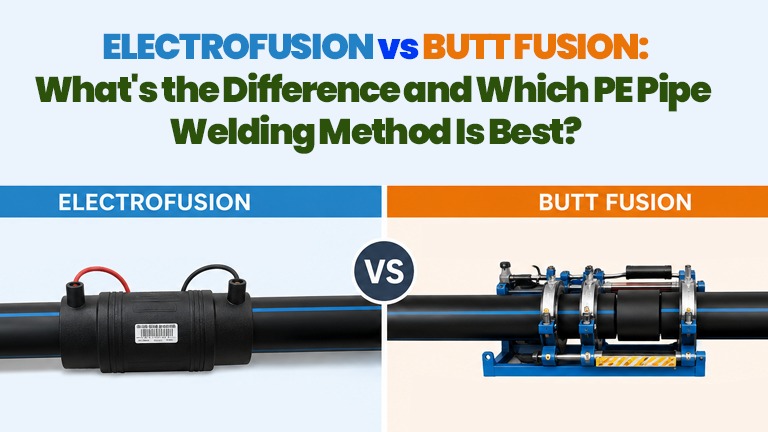
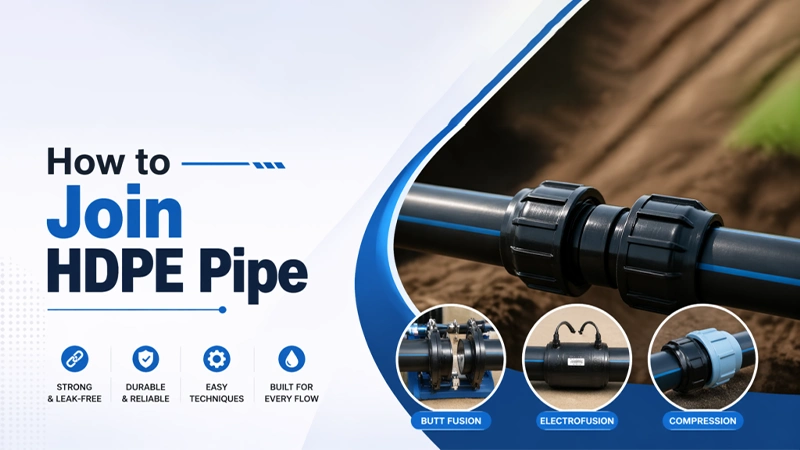
Both materials use butt-fusion and electrofusion joining techniques; however, the welding parameters and cooling times would vary due to resin grade (a practical detail for installers to account).
Chemical and Environmental Resistance
Both types are resistant to many routine chemicals; however, specific exposures (chlorinated water, solvents, aggressive soils with fertilizers) can have different chemical effects. Favorably, the higher degree of crystallinity generally looks to provide greater chemical resistance and reduce permeation exposure in HDPE.
And both materials generally have a UV protection coating (usually carbon black), but the % of carbon black (and stabilisers) affects life under sunlight. Again, you rarely see a competitor piece quantifying how UV stabiliser content, soil chemistry, or neighborhood pollutants affect expected life, including that in specification documentation.
Applications in Water Infrastructure
MDPE water pipe is widely used in service lines, low-pressure distribution, and gas lines, as its flexibility is beneficial. HDPE (especially PE100 grades) is more commonly used for trunk mains, higher-pressure potable water lines, industrial piping, and those buried crossings subject to heavy loads or cold temperatures.
Important, often overlooked practical considerations include: the potential influence of the material selection based on dimension ratio (DR), minimum bend radius, and the joint available in your local market.
Also, pay attention to hydraulic considerations; if you choose a thicker wall (for HDPE), you may decrease the internal diameter slightly, and that could have an effect on flow.
Cost, Lifespan, and Maintenance Considerations
Cost only tells part of the story when considering the initial cost of the material. HDPE resin or PE100 pipes will have a higher unit cost per metre than MDPE Pipes, but you will need thinner walls for the same pressure rating, and you get a longer lifespan, which is potentially a lower life-cycle cost.
Costs for installation can differ; MDPE Pipes Installation may more effectively value engineer complex bending with reduced labour/time; even though HDPE will have higher costs for handling HDPE, given its stiffness, this may lead to less replacement frequency.
Don’t forget other hidden costs; fusion training or certification, repair parts or even finding locally available, certified fittings.
Choosing the Right Option for Your Project
Choose and identify which plastic material meets your entire context, including design pressure, DR, temperature extremes, soil chemistry, expected mechanical loads (traffic, settlement, seismic), installation strategy (trenching versus HDD), capabilities on joining onsite, and lifecycle cost intent.
For projects that involve high-pressure deep burial, cold climate projects, and/or long projections of service life, HDPE/PE100 is typically the preferred option. For projects that involve tight bends, low distribution pressure, and lower up-front cost, MDPE Pipe Fitters is typically preferred.
In all cases, specify certified resin grades, and onsite characteristic testing (e.g., burst and fusion tensile testing, slow crack growth testing data, etc.) in the specifications.
Conclusion
Both MDPE Pipes and HDPE Pipes are very good structural performance materials for pipe applications, but they also have optimized performance envelopes. Specifying pipe material should be more than simply indicating “density” to account for additional resin grades.
Molecular structure, UV and/or chemical exposures, jointing processes, and installation realities, lifecycle costs, and local standards. When you provide these practical engineering and environmental, and lifecycle contexts.
Which are often ignored in competing articles, you will greatly increase the usefulness of your article or specification for engineers, contractors, and procurement groups to discuss achievable and cost-effective solutions to actual projects.
FAQ’s
Q. What is the difference between MDPE Pipes and HDPE pipes?
Q. What is the difference between MDPE and HDPE cable jackets?
Ans: MDPE cable jackets have flexible jackets and moderate protection, while HDPE jackets have higher density, higher strength, abrasion ,and weather resistance.
Q. What are the disadvantages of MDPE pipe?
Ans: MDPE pipe may have low pressure resistance, temperature ratings, and is bettersuited for lighter industrial or lower stress applications.
Q. What is the difference between LDPE and MDPE pipe?
Ans: LDPE pipe is softer, highly flexible, and lower density, while MDPE is stronger than LDPE but has flexibility and increased resistance to cracking.