MDPE Pipe Installation in India: Step-by-Step Guide for Reliable Setup

In India, the growing infrastructure sector relies heavily on MDPE (medium-density polyethylene) pipes for various applications. These applications include water supply systems, gas distribution systems, and irrigation systems, just to name a few.
While most MDPE pipes are manufactured to the highest standards, failures can still occur as a result of poor installation practices. This includes defective jointing methods, poorly prepared trenching, and/or pipes that have not been pressure tested before installation.
The purpose of this article is to provide you with an easy method for installing MDPE pipes correctly in India. The article provides a step-by-step guide that will assist you with ensuring your installation meets all relevant government regulations, as well as providing long-lasting performance from your installed MDPE Pipes.
Understanding MDPE Pipes and Their Applications
Medium-density polyethylene pipe (MDPE) is a type of thermoplastic pipe made from a mild polyethylene resin. They provide a combination of strength and bendability.
Common Applications of MDPE Pipes in India
- Drinking water supply systems
- Gas distribution systems
- Agricultural irrigation
- Industrial fluid movement
- Underground utility piping
Key Advantages of MDPE Pipes
- Excellent resistance to corrosion and chemical substances
- Greater flexibility for uneven ground surfaces
- Longer lifespan (up to 50 years) than other types of HDPE pipe
- Lightweight & easy to transport
Are all the pipe markings confusing you? Using this guide to mdpe pipe color meanings and applications, you can decipher color codes and choose the appropriate pipe for each application.
MDPE Pipe Installation Procedure: From Planning to Jointing
Step 1: Planning and Site Assessment
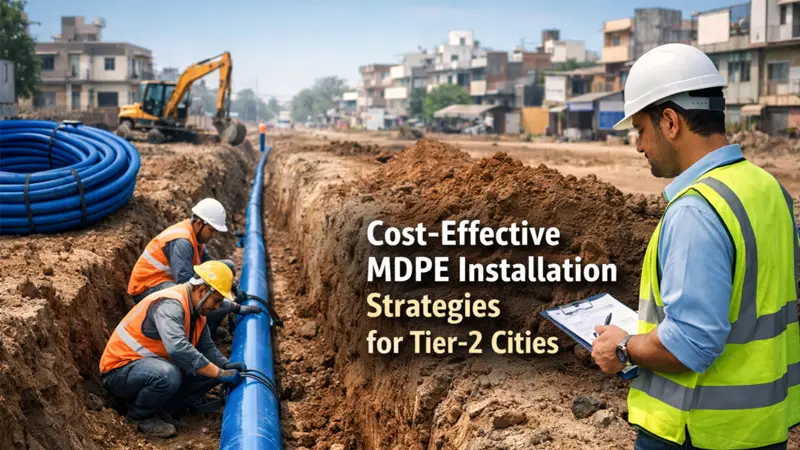
Before the trench is dug for putting in the actual pipeline, there are many things that must be properly planned. To be able to properly plan the installation, several considerations will need to be addressed. These considerations are:
- The pipeline route alignment
- The type of soil and ground conditions where the pipeline will be installed
- Load factors (i.e., traffic, buildings, and machinery)
- Local regulations for safety and permitting
A detailed site survey will help identify any obstructions (i.e., rocks, existing utilities, and/or water tables) that could affect the installation of the pipeline.
To achieve this, it is best to do the following:
- To verify pipe specifications (diameter, pressure rating, SDR)
- To determine compliance with IS standards (for example, IS 4984 for water supply);
- To prepare installation drawings and safety plans
Step 2: Trench Excavation and Preparation
The way you prepare your trench is key to pipe stability and performance over time.
Trench Dimensions and Depth Requirements
Your trench’s width must allow for jointing and backfilling properly. Likewise, the depth should provide sufficient protection from surface loads and temperature variance.
Bedding Preparation Guidelines
- Use sand or other fine granular materials to create bedding
- Ensure that the surface is smooth, level, and free of any protrusions
- Compact bedding material enough to establish a firm base; avoid compacting too much or too little, as this can lead to settling
MDPE pipe should not be placed directly onto uneven or rocky substrates because this creates stress on the pipe at points of contact.
Are you confused about color selections? You can choose the best pipe for your water system by using this guide to the differences between blue and black MDP pipes.
Step 3: Pipe Handling and Storage on Site
Handling and storing MDPE pipes can be done easily with some simple guidelines to follow:
- Storage should take place on a flat surface with no sharp materials or heavy objects nearby.
- Be sure to keep the pipes out of direct sunlight for long periods.
- When handling pipes, avoid dragging them on a rough surface; instead, use slings when lifting them rather than using metal hooks.
- Before installing any pipes, be sure to inspect them for damage.
When pipes are handled properly, micro-cracks will not form that may not show up right away, but can lead to failures in the future.
Are you sick of expensive bills and wasted water? This clever water management technique enables you to efficiently reduce expenses and maximize usage.
Step 4: Pipe Laying and Alignment
Pipes will then be carefully positioned in preparation for installation into the trench once the trench has been prepared.
The pipe installation process includes:
- Lifting pipes down gently into the trench
- Positioning pipes straight (not forcing bends into the pipe)
- Recognition and allowance for thermal expansion/contraction of the pipeline.
Even though MDPE pipelines are flexible, if the pipe bends excessively beyond the manufacturer’s guidelines, the connections may be compromised.
Pipe alignment tips:
- Maintain a consistent slope of pipe (gradient).
- Do not create additional (unnecessary) joints.
- Clean and dry pipe end surfaces to be connected before making up the joint.
Are you having trouble with systems that don’t work well? These top water management solutions help you use fewer resources and make your operations run more smoothly.
Step 5: Jointing Methods for MDPE Pipes
The most important element of MDPE plastic piping installation is making good joints, as a poorly made joint can impact the integrity of the entire installed system.
In India, the numerous different types of joints are:
Butt Fusion Welding
Joints—pipe ends are thermally fused; the method of jointing is the creation of a solid, leak-free joint intended for the larger diameter pipeline systems.
Electrofusion Welding
Electrofusion joints are made with electrofusion fittings (which have heating coils within them) and are particularly suited to use in repair applications and restricted access locations.
It is critical that only qualified persons are permitted to perform the process of fusion welding (i.e., butt and electrofusion).
Having trouble with erratic water quality? This guide to township water treatment systems demonstrates how to supply every home with dependable, clean water.
Common MDPE Pipe Installation Mistakes to Avoid
Avoiding common errors can significantly improve pipeline performance.
Frequent mistakes:
- Inadequate trench bedding
- Improper fusion welding parameters
- Rushing backfilling without inspection
- Ignoring expansion allowances
Attention to detail during installation prevents leaks and system failures.
Conclusion
The installation of MDPE pipe systems in India requires detailed project planning, professional installation, and effective quality management to achieve the MDPE pipe systems’ long-term performance requirements.
When properly installed, MDPE pipe systems offer high levels of dependability, safety, and durability for many types of applications, such as rural water supply systems and large industrial network applications.
Through this step-by-step guide, both contractors and engineers can ensure their respective MDPE pipe systems will function effectively for many years, thereby reducing long-term maintenance expenses while supporting India’s ongoing development of infrastructure projects.