
The ideal treatment capacity will vary depending on the population served and the average daily use rate within that township. The treatment capacity needed for township systems is typically 100 KLD to several million liters of treated water daily.
Why Every Township Needs Its Own Water Treatment System
Clean Water is a vital component of our everyday lives and also an important asset for the future, regardless of where you live or the size of the community you live in. The community water treatment system provides consistent access to clean, safe water free from harmful contaminants.
This allows communities to be proactive in managing their own resources and providing quick responses to local environmental issues while maintaining the public health standard. Community-owned water treatment systems also take into account the concept of sustainability.
Community-owned water treatment systems empower communities to establish long-term economic stability through the investment in and maintenance of a community water treatment system.
Every community that invests in and owns their local water treatment facility will empower themselves and help create a healthier building, more self-sufficient future for every community member.
The Growing Need for Localized Water Treatment
Urban Expansion & Rising Water Demand
As urbanization continues and suburban towns continue to grow, the need for water will also increase. More people moving into a town will put additional strain on the water supply in that town. As a result, there will be water shortages at peak times of the year.
In many cases, a township with a rapidly growing population may not have enough municipal water resources to meet the demands of its residents; thus, these areas can expect to experience a constant shortfall between resources and needs.
Stress on Centralized Municipal Systems
Centralization of water systems at the city level, as a result of the urban population pressure, places a significant burden on existing water supply systems (pipes, pumps, and reservoirs).
The excess demand placed on the water delivery systems overwhelmed the operators and the utility, resulting in disruption of water services to neighbourhoods and the potential for large-scale failures resulting from water service disruptions when maintenance and repairs and the resulting pipeline ruptures occur.
Increasing Contamination in Groundwater & Surface Water
The contamination of surface and groundwater resources adjacent to cities due to the practices of manufacturing, industrial, wastewater and agricultural chemicals has increased and continues to increase over the years.
Because of these contaminants, unprocessed water will not be safe for drinking. Townships that use either boreholes or direct external intakes (`unprocessed’ raw water) will not have a consistent source of raw water meeting their needs.
An efficient water treatment system can only work well when it is combined with a high-quality distribution lines – find out how MDPE pipes can enhance water management systems in urban and township systems.
It is also worthwhile to choose the appropriate distribution materials, as the difference between blue and black MDPE pipe might enable you design a more efficient water infrastructure when supplying towns with water.
What Is a Township Water Treatment System?
How It Works (Intake → Treatment → Storage → Supply)
Essentially, a Township’s Water Treatment Plant (WTP) is a self-sustained operation. It uses different sources of water (such as boreholes, rivers, canals, and tankers), treats these waters with several different processes, and stores them in elevated storage tanks.
Difference Between Centralized & Decentralized WTPs
The difference between Centralized and Decentralized WTPs is that the Centralized WTP provides treatment for the entire city, while the Decentralized WTP provides treatment to the individual township or community. This means that each community will determine what level of treatment will be required to provide customers with the best quality for their needs, when to provide treatment, and how they will operate.
Types: STP, WTP, Compact Units, RO-Based Systems
Most townships today utilize a variety of systems to meet their water needs, such as: a municipal water treatment plant supplying clean drinking water, a sewerage treatment facility for recycling wastewater, compact treatment systems for small clusters of homes, as well as reverse osmosis based systems in areas with high total dissolved solids (TDS). The main purpose of each type of system is to provide water meeting specific standards and to comply with local environmental regulations.
Key Reasons Every Township Needs Its Own WTP
1. Consistent Access to Clean & Safe Drinking Water
Township residents can rely on township water treatment facilities for clean drinking water regardless of what is supplied by the municipality. Even when municipal water has impurities or does not arrive in large quantities, a township water treatment facility can provide residents with the same quality and reliability.
2. Reduction in Waterborne Diseases
Poorly treated or untreated water can expose households to bacteria, viruses, heavy metals and chemicals, significantly increasing the likelihood of becoming ill. Utilizing township water treatment facilities to filter out contaminants greatly reduces the risks associated with waterborne illnesses in areas where people live close together and where disease outbreaks can occur rapidly.
3. Independence From Municipal Failures
Many municipal networks experience interruptions in their water supply due to problems with the local/pipeline infrastructure, planned maintenance shutdowns, or seasonal water supply shortages. Townships that do not have their own water treatment plant must rely on tanker services, which tend to be expensive and unreliable.
4. Lower Long-Term Cost of Water Supply
While municipalities must invest in a WTP up front, the long-term costs associated with operating one of these facilities are actually lower than those incurred through reliance on portable water sources. By virtue of recycling treated wastewater and implementing energy-efficient technologies, township WTPs can reduce the amount of fresh water that must be purchased, thus reducing their operational costs.
The various color codes in the MDPE pipes are used in different applications and this is important information to know in the design of water delivery lines – read more on the MDPE pipe colors meanings and uses.
Advanced Technologies Used in Township Water Treatment
Sand Filters, Carbon Filters, Membrane Filtration
Most treatment facilities utilize sand filters to trap suspended materials and carbon filtration technology for removing chemical compounds and obnoxious odors. Advanced water purification can be implemented by utilizing membrane filtration technology, which removes the smallest contaminants in addition to improving overall water clarity.
UV & Ozone Disinfection
UV and ozone based disinfecting technologies have become popular solutions for eliminating harmful microorganisms without chemical additions. Utilization of these methods results in the production of potable water while preserving the integrity of the original taste and odor of the water.
Reverse Osmosis (for high TDS areas)
In areas where there is a concentration of saline and mineral content, reverse osmosis (RO) has proven to be an effective means of reducing total dissolved solids to acceptable levels. Typical township-scale reverse osmosis units produce potable water regardless of the levels of pollution found at the source.
Treated Wastewater Reuse – A Critical Township Advantage
Reuse for Gardening, Flushing, Cooling Systems
The township’s STP will provide treated wastewater for irrigation landscaping, flushing toilets, and cooling towers instead of using fresh water, reducing the demand for fresh water by using treated wastewater to satisfy non-consumptive uses.
Reduces Freshwater Dependency by 40–60%
Townships that recycle treated wastewater can reduce their overall consumption of fresh water by as much as 60%. This reduction allows for greater self-sufficiency and less reliance on borewells and municipal pipelines.
Helps Townships Meet Environmental Compliance Norms
There is increasing pressure from regulatory bodies on townships to implement treated wastewater recycling systems to comply with pollution standards and avoid fines.
Environmental & Social Impact of Having a Township WTP
Reduces Water Extraction From Rivers & Borewells
Due to the continuous increase in the demand on natural water bodies, townships will need to reduce their reliance on natural water bodies for sourcing.
Protects the Local Ecosystem
The ability of Wastewater Treatment Facilities to recycle or reuse processed wastewater and the more effective treatments contribute significantly to the reduction of external sourcing (e.g., using natural water); by preserving the local ecosystem, the township will be able to minimize its demand on external sources for its residents and preserve and restore the local ecosystem.
Ensures Long-Run Water Security for Residents
WTPs will allow the township to remain secure in terms of its water supply through the process of developing a Water Security Program (WSP). The Water Security Program will provide the township with long-term water security regardless of the changing climate patterns.
Selection of piping material has an impact on the durability and maintenance – see our MDPE vs HDPE comparison guide to see whether it is the best choice when building long-term township infrastructure.
Cost Comparison: With vs Without a Township Water Treatment System
Upfront Installation Cost
Each township must have an investment in infrastructure such as tanks, pipelines and treatment units. While the up-front price may be significant, the long-term dependability and improvements in quality make this a cost-effective investment.
Operational Savings
The cost efficiencies from operating WTPs greatly diminish overall dependence upon costly external water sources since $2.00+ less per gallon of wastewater is reused versus treated.
Long-Term ROI Through Water Reuse
Years of savings in residential water bills and reduced capital needs to build WTPs provides the most significant return on investment from the use of reclaimed water or effluent.
Challenges Townships Face Without a Water Treatment Facility
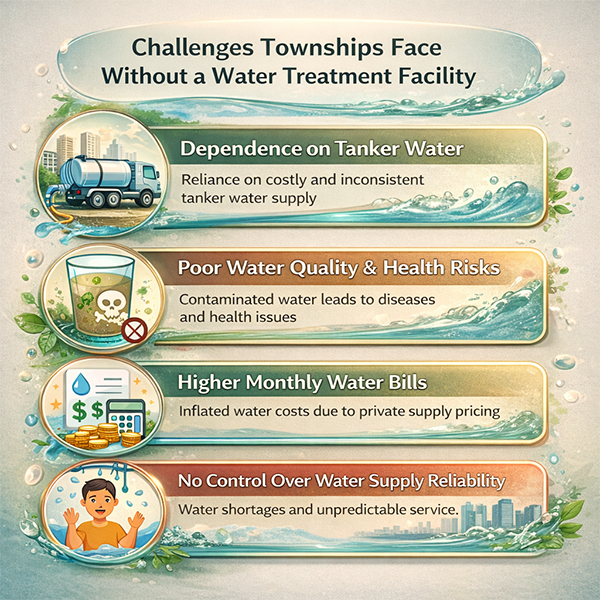
Dependence on Tanker Water
Townships without water treatment plants (WTP) often rely on tanker-delivered supplies; however, the quality of these tanker-supplied waters is frequently suspect. As a result, these township residents experience both a growing cost and delay in the delivery of their water supply.
Poor Water Quality & Health Risks
Townships without water treatment plants (WTP) often rely on tanker-delivered supplies; however, the quality of these tanker-supplied waters is frequently suspect. As a result, these township residents experience both a growing cost and delay in the delivery of their water supply.
Higher Monthly Water Bills
Township residents pay significantly higher monthly maintenance fees due to purchasing their water from external suppliers.
No Control Over Water Supply Reliability
Due to their lack of control over their own water supply systems, township residents cannot maintain consistent quality or predict the timing of deliveries.
How to Choose the Right Water Treatment System for a Township
Daily Water Demand Assessment
Actual daily consumption provides information about the treatment capacity needed. A more significant population base may require multiple treatment units to operate in parallel.
Source Water Quality Testing
Testingfor contaminants, total dissolved solids (TDS), and microbiological content will help determine what type of treatment technology is most suitable for the source water.
Choosing Correct Capacity (KLD)
To meet peak demand, treatment equipment must be correctly sized; if too large, it may use unnecessary energy, and if too small, it will be ineffective during peak-use periods.
Compliance with Local Pollution Control Board Norms
All treatment systems should be designed and operated per the Discharge Regulations of the Local Pollution Control Board and local Drinking Water Quality Standards. If compliance is maintained, there should be no interruption in the operation of treatment systems or legal issues regarding the operation of treatment systems due to noncompliance.
Case Study / Example Section (Optional)
How Modern Townships Save Water Using In-House WTP + STP
To decrease reliance on freshwater, many modern communities have adopted Combined Water Treatment Plant (WTP) and Sewage Treatment Plant (STP) solutions through water recycling and use of recycled waters to maintain green spaces and decrease the number of tankers used to supply potable water resources to communities.
Before & After Water Reuse Impact
Townships that formerly depended on borewells and tankers for drinking water find that treating their wastewater on-site versus having it trucked to them creates substantial cost savings, improves community sustainability and increases residents’ wellness.
FAQs
What size of WTP does a township need?
Does a WTP reduce dependency on tankers?
All township WTP systems provide reliable in-house water supplies, which helps to improve the quality of water supplied by eliminating/tolerating the need for tanker trucks that deliver treated water during an emergency event.
Can treated water be used for drinking?
Treated and disinfected water can be used as drinking water if the treatment meets State Water Quality Standards. Most township WTP systems will supply this treatment-grade water as drinking quality immediately following treatment.
What is the lifespan of a township WTP?
If a township WTP is professionally maintained and routinely upgraded, it may remain in service for as long as 15–25 years without interruption.
Conclusion – A Township WTP Is No Longer Optional
The township water treatment plant is critical for providing an uninterrupted supply of safe, affordable, and sustainable water as the demand for a more independent economy (i.e., water supply) grows.
Appropriate site and site selection, sufficient investment in modern technologies, and a strong and timely approach to building the necessary infrastructure will provide the township with sustainable water security for the long term and improve overall quality of life for township residents.
When suppliers like goflo support townships in this regard, the township not only achieves a high level of operational efficiency but also provides the community with premium quality, sustainable, and cost-effective water management solutions for a minimum of the next fifty (50) years.
The type of pipes used in township water safety is important: our article on MDPE pipe safety in drinking water describes the effectiveness of MDPE lines in maintaining the health of potable water.