
Ans: The standard density used is 950 kg/m³, although it can range between 930–970 kg/m³ depending on material grade.
How to Calculate HDPE Pipe Weight Per Meter
When you need to estimate the weight of HDPE pipe per meter, this information is vital for planning your project accurately to avoid shortages or difficulties in handling material. Knowing the weight of your HDPE pipe per meter also assists you with estimating project costs and managing transportation.
HDPE pipes are very light, however, there is still an element of variance in pipe weights that can depend on certain factors such as the outer diameter (OD), wall thickness (WT), and pipe standard dimension ratio (SDR). This guide was constructed with the intention of making the process of calculating your hdpe pipe weight per meter straightforward to engineers, contractors, and buyers by avoiding the possibility of confusion and/or incorrect calculations.
Understanding HDPE Pipe Weight Calculation Basics
It is important to calculate the weight of HDPE piping per meter for transportation/delivery purposes; estimating costs; and planning/estimating the required amount of materials for installation. HDPE (High-Density Polyethylene) piping is commonly used in applications such as water supply, drainage, and industrial pipe applications because of its strength and flexibility.
The weight of HDPE piping per meter length will depend upon the size of the pipe and the density of the pipe material. Although HDPE pipe has a lower weight compared to metal pipe; it is still necessary to make accurate calculations when planning the structures and loads that will be placed on top of them.
Things to keep in mind when calculating the weight of HDPE piping:
- The outside diameter (OD) of the pipe
- The wall thickness of the pipe
- The density of HDPE is typically between 950 kg/m³
- The standard dimension ratio (SDR) can affect the wall thickness, and
If you understand these basic principles, you can avoid mistakes when purchasing or transporting your HDPE pipe.
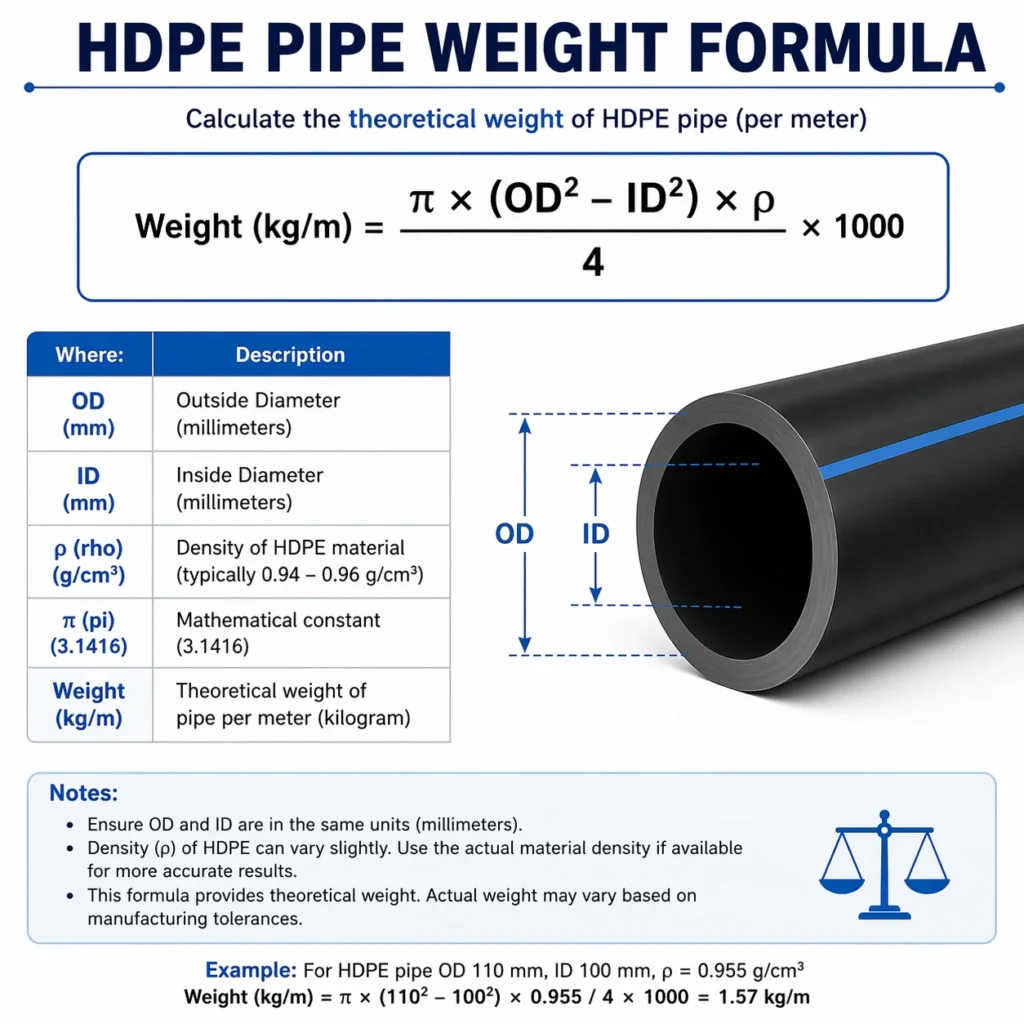
Formula to Calculate HDPE Pipe Weight per Meter
The way that HDPE pipe weight is typically calculated is as follows:
- Weight (kg/m) = π × (D – t) × t × ρ
Where
- D – The outer diameter (in meters)
- t – The wall thickness (in meters)
- ρ (rho) – The approximate density of HDPE (950 kg/m³)
- π (pi) = 3.1416
This calculation first finds the volume (of the pipe), then uses that number, and the density, to find the weight.
Important notes on this equation:
- You must always convert all dimensions from millimeters (mm) to meters (m) before making any calculations.
- You need to use the actual value of SDR (Standard Dimension Ratio), in order to get the proper thickness of the pipe.
- This assumes that the material is uniformly distributed throughout the pipe.
Every engineering/piping industry contacts routinely use this formula and it is widely accepted in the engineering and piping industry.
Key Parameters Required (OD, SDR, Thickness & Density)
There are a few important characteristics that you will need to know in order to determine the weight of an HDPE pipe accurately.
1. Outer Diameter (OD)
- In millimetres, the outer diameter represents the total size of the pipe.
- Pipes typically range from 20mm to 1200mm in size.
2. Wall Thickness (t)
- The thickness of the wall will determine how strong the pipe is going to be.
- It is calculated using the SDR or is included in the specifications.
- If a pipe has a thicker wall then it will have a greater weight.
3. SDR (Standard Dimension Ratio)
- Formula: SDR = OD/thickness
- A lower SDR indicates that the pipe wall is thicker and a higher SDR indicates that the wall is thinner than the other.
4. Density (ρ)
The density of HDPE pipes generally ranges from 930 kg/m3 to 970 kg/m3 and the value most commonly used is 950 kg/m³.
The check list to use before calculating the weight of HDPE pipes is simple.
- Confirm the OD value of the pipe is measured in millimetress.
- Get your correct SDR value.
- Convert all values to metres.
- Use a standard density of 950 kg/m³ unless told otherwise.
Step-by-Step Method to Calculate Weight per Meter
Here’s a simple step-by-step method to calculate HDPE pipe weight per meter:
Step 1: Convert Units
Convert OD and thickness from mm to meters.
- Example: 110 mm = 0.11 m
Step 2: Find Wall Thickness
If SDR is given:
- Thickness = OD / SDR
Step 3: Apply Formula
Use the formula:
- Weight = π × (D – t) × t × ρ
Step 4: Solve the Equation
Insert values and calculate step by step
Example Calculation:
- OD = 110 mm (0.11 m)
- SDR = 11
- Density = 950 kg/m³
- Thickness = 0.11 / 11 = 0.01 m
Now apply formula:
- Weight = 3.1416 × (0.11 − 0.01) × 0.01 × 950
- Weight ≈ 2.98 kg/m
Conclusion
Understanding the formula for calculating the weight of HDPE Pipe per meter is relatively simple once you know the parameters to use. To calculate the weight accurately, you must have the proper outer diameter and wall thickness of the pipe, as well as the density of the material being used.
Once these parameters are established, you can calculate the accurate weight for both planning and executing the project. This will help with more accurate estimating for costs, transportation management and structural design. As an engineer, contractor or supplier of piping products, having a mastery of the calculation will provide you with efficiency and reduce the chance of mistakes in your piping projects.
Explore reliable HDPE solutions for durable and efficient pipeline installation.
FAQ
Q: What is the standard density of HDPE used in calculations?
Q: Can I calculate weight using SDR directly?
Ans: Yes, SDR helps determine wall thickness, which is then used in the formula to calculate weight.
Q: Why is HDPE pipe lighter than metal pipes?
Ans: HDPE is a plastic material with lower density compared to metals like steel, making it lightweight and easier to handle.
Q: Is there an easier way than manual calculation?
Ans: Yes, you can use manufacturer charts or online calculators, but understanding the formula ensures accuracy.