What Is Smart Water Management? Benefits for Cities, Industries & Housing Societies

Our planet’s most valuable natural resource is water. Urbanization, Climate change and increased demand on natural resources create a burden on traditional water sources to fulfill these needs.
The ability to manage our water resources effectively through the use of Smart Water Management Technology provides us with the tools necessary to transform how we use, distribute, conserve, and monitor the use of water.
This article will review the definition of Smart Water Management, provide reasons for its importance, explain some of the key technologies that have enabled Smart Water Management to develop, and describe the benefits it will ultimately provide to cities and industries, as well as Housing Societies.
Additionally, we will discuss how goflo MDPE pipes contribute to the modernisation of water management systems.
What Is Smart Water Management?
Smart Water Management utilizes cutting-edge technologies such as IoT, Sensors, Data Analytics, AI & Smart Infrastructure to help monitor and optimize the state of smart water management, as opposed to just traditional ways of using water.
Collects continuous streams of data that allow for quick decision making, predictive maintenance and better allocation of resources. Comprehensive and effective Smart Water Management effectively manages Water’s Distribution, Use and Quality.
Apart from efficiency and analytics, smart water systems also consider health standards — read more about MDPE pipe safety for drinking water in our guide.
Key Components of Smart Water Management
A smart water management system incorporates a combination of elements that work together to improve the efficiency and effectiveness of our water resources.
- Internet of Things (IoT) sensors and devices to collect real-time data on flow/pressure/quality and leaks from the infrastructure of the entire water system including pipes, tanks, filters and treatment plants.
- Data will be analysed immediately upon collection to identify any anomalies such as leaks, pressure surges or contamination, enabling rapid resolution.
- Automated control systems enabling water pumps, valves and other treatment processes to be controlled remotely, thereby eliminating many manual labour hours and lowering costs while increasing operational efficiency.
- Predictive maintenance, using AI and machine learning, combines real-time data with historical records to anticipate when equipment failures may occur and/or when maintenance is due.
- GIS is a technology that enables mappers to produce a map of the complete water network, facilitating better planning, management and decision-making processes.
Why Smart Water Management Matters
There will be a substantial increase in global water demand as we approach the 2050’s. The need for smart and efficient management and usage of water has never been more critical than today. The following are the key areas where smart systems can help address water resource challenges:
Water Scarcity
The world currently has many areas where there is a shortage of water due to drought conditions, populations growing at a rapid pace, and the excessive use of groundwater. Smart systems permit the effective use of available water supply by optimizing its use.
Water Infrastructure
Old, outdated water infrastructure creates high levels of leakage and creates significant waste in terms of efficiency. Smart water management uses sophisticated monitoring systems to identify water loss quickly, thereby reducing the amount of water wasted.
Rising Cost of Water
Water treatment, pumping, and distribution systems require a large amount of energy and money to operate. Smart water management can make these processes more efficient and decrease the costs associated with operating these systems.
Environmental Sustainability
Smart water management demonstrates a significant reduction of the energy footprint associated with large-scale water systems and is critical to supporting all Sustainable Development Goals.
Benefits of Smart Water Management for Cities
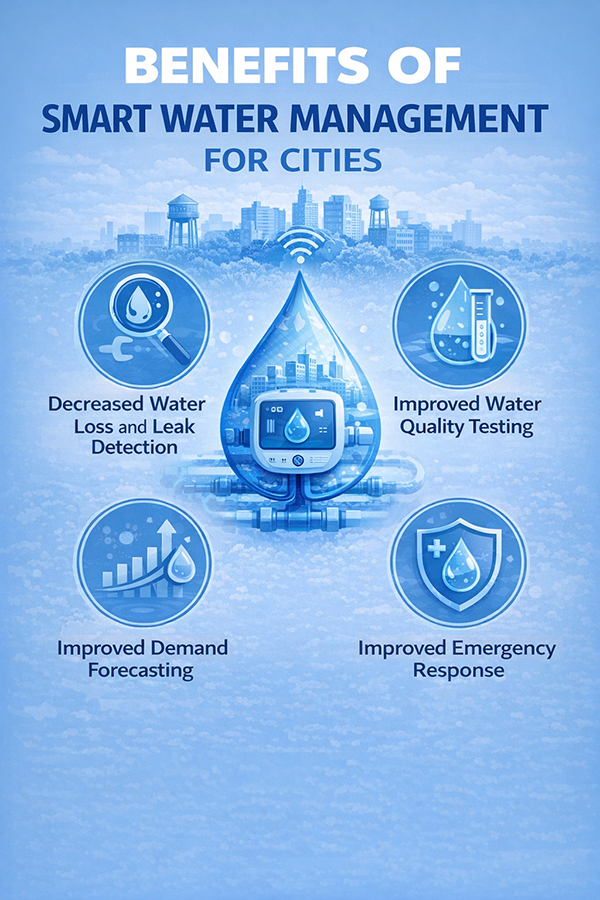
Smart water solutions benefit cities with greater positive contributions than simply solving specific problems; they may provide the following benefits:
Decreased Water Loss and Leak Detection
Most of the water supplied to urban areas is lost from the distribution system before it reaches the end user. The majority of this loss results from leaks and pipe breakages within the distribution system. Smart sensors along with data analytics provide city agencies with the ability to identify potential leaks well in advance of the break.
Improved Water Quality Testing
With the use of smart systems, urban water agencies can monitor their drinking water for several parameters simultaneously including: pH level, turbidity level, and levels of impurities, providing cities with effective means of monitoring the health and well-being of their citizens.
Improved Demand Forecasting
The data generated by the use of smart systems allow city planners to monitor consumption and adjust their infrastructure development plans and/or distribution models earlier in the consumption cycles.
Improved Emergency Response
Smart systems help urban water agencies quickly isolate the location of pipeline failures and to identify the source of contamination. Due to the speed of response made possible by the use of smart sensors and analytical systems, the agency has an opportunity to restore service as quickly as possible.
When designing a smart water network, choosing the right pipe material is essential — check our comparison to understand the difference between MDPE vs HDPE pipes.
Benefits for Industries
Water is essential to the many aspects of the manufacturing processes in an industrial facility. A smart water management program has the potential to make a significant impact on an industrial operation:
Water Usage Optimisation
Through real-time water usage monitoring, industries can monitor their water usage on a per-process basis, thus allowing them to identify ways to reduce waste and improve efficiency.
Water Discharge Compliance
Many industrial operations use water that will be discharged as waste into the environment; all industrial operations must comply with regulations set forth by local, state, and federal governments regarding the quality of their wastewater discharge.
Equipment Predictive Maintenance
Many components of an industrial operation are reliant on equipment that can fail, causing equipment breakdowns, disrupting production, and incurring the cost of excessive downtime and repairs. Predictive maintenance of these components will optimize the use of this equipment.
Benefits for Housing Societies
By leveraging Smart Water Management, modern residential complexes and greenfield developments can improve their efficiency through:
Transparent Billing
Residential complexes will provide residents with direct, real-time access to the amount of water consumed (through IoT-enabled water meters). This increased awareness of their water consumption patterns will encourage them to conserve water. (Providing transparency via actual billing based on actual water consumption also promotes fairness).
Detecting Leakage
Housing societies are often faced with hidden leaks (in the water distribution system), making it difficult for them to detect the problem and fix it quickly. Smart Water Management Systems provide a method for monitoring water consumption and notify residents or facility managers when it has been determined that there is a leak (based on analyzing the owner’s water consumption pattern).
Better Water Distribution
Smart Water Management Systems provide a consistent water distribution system, leading to improved water pressure (preventing low-pressure problems) and fair access for all homeowners.
Increased Conservation Awareness
Consumers view their water consumption pattern (via the IoT-enabled water meter) and become more aware of their water consumption habits, ultimately creating more conservation-oriented behaviours.
Smart water management systems rely on robust piping solutions to minimize leakage — learn more about the advantages of MDPE pipes for water distribution in our detailed blog.
The Role of goflo MDPE Pipes in Smart Water Management
goflo MDPE Pipes improve the smart water infrastructure with their high leak resistance, excellent durability, and long-term reliability. goflo MDPE Pipe’s superior joint integrity coupled with its exceptional crack resistance leads to less wasted water and a more precise means of monitoring water losses when used with smart sensors.
Conversely, the flexibility of the goflo MDPE Pipe allows it to be easily installed in difficult terrains and small congested urban spaces and provides fewer joints, which reduces the chances of leakage and the amount of downtime.
goflo MDPE Pipe also provides a high degree of chemical and corrosion resistance and, therefore, protects the quality of water and prevents contamination. goflo MDPE Pipe has a smooth internal surface that offers excellent integration with IoT sensors and generates accurate data. Providing a long life and low maintenance expense results in lower ownership costs.
Conclusion
Smart water management requires a shift in strategy to evolve to meet the global challenges of the 21st century. With continuous monitoring, automated systems, and data analysis, cities, industries, and housing communities can improve their water-use efficiency and reduce waste; improve quality; and reduce costs.
Relevant and efficient infrastructure like the goflo MDPE pipe will provide a valuable asset in the evolution of a way for modern water distribution systems. The goflo MDPE Pipe is ideal for use in modern water systems because they have the flexibility, strength, and compatibility needed to work with modern technology.
To learn more about innovative products and solutions to help support smart water management, visit https://goflo.in/. See how goflo is helping to reshape how water gets distributed.